130 North Jackson Street, Danville IL 61832
 217-443-3592
 734-442-0101 |

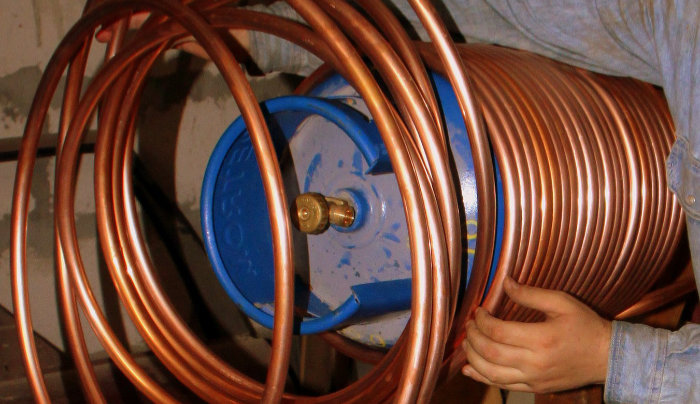
Manufacturers that need to straighten coiled tubing require equipment that can produce consistent, accurate results without damaging the material. Coiled tubing straightener machines are available in several configurations, with each model designed for different materials, tube sizes, production speeds, and secondary operations.
Although tube straighteners share a similar basic purpose, some machines can also cut tubing to length, lubricate the material, resize tube ends, or perform end-forming operations. Choosing the right system depends on the tubing being processed and the requirements of the finished part.
How Do Machines Straighten Coiled Tubing?
To straighten coiled tubing, the material is pulled from a coil and guided through a series of carefully positioned rollers. These rollers apply controlled pressure to remove the bends and curvature created during the coiling process.
As the tubing passes through the straightening section, upper and lower rollers repeatedly flex the material in different directions. This process gradually corrects the shape of the tubing until it exits the machine with a straight, uniform profile.
Two primary forces contribute to the straightening process:
- Bend straightening, which repeatedly flexes the tubing to remove its natural coil.
- Pressure straightening, which applies controlled force to correct the tube’s shape and alignment.
The rollers must be adjusted for the tubing’s material, diameter, wall thickness, and coil condition. Proper adjustment helps manufacturers straighten coiled tubing while minimizing distortion, surface damage, and inconsistent results.
Benefits of Straightening Coiled Tubing
Processing tubing directly from a coil can help manufacturers improve production efficiency and reduce material handling. A properly configured tube straightener can provide several benefits, including:
- Consistent tube straightness
- Repeatable cut lengths
- Reduced manual handling
- Faster production cycles
- Improved material utilization
- Integration with cutoff and end-forming operations
- More consistent finished components
By combining multiple production steps into one system, manufacturers may also reduce the need to transfer tubing between separate machines.
Different Types of Coiled Tubing Straighteners
A tube straightener’s primary purpose is to straighten tubing supplied in coils or rolls. However, Tridan machines can include additional capabilities based on the needs of the application.
STVC Tube Straightener
The STVC Tube Straightener is designed to straighten coiled tubing made from materials such as copper and aluminum. It can process tubing from a coil and cut it into the required lengths.
The system can also include integrated lubrication and chip-free cutoff capabilities. These features help create a cleaner and more efficient production process while reducing the need for separate equipment.
STMC and STMBC Tube Straighteners
The STMC and STMBC models combine tube straightening with additional production capabilities. Depending on the machine configuration, these systems can include belt feeding, cutting, and tube end-forming operations.
Integrated end-forming capabilities allow manufacturers to straighten coiled tubing and prepare the ends of the tube within the same production process. This can be useful for applications that require bell ends, flares, resizing, or other finished tube-end shapes.
STQC Tube Straightener
The STQC is designed for straightening and cut-to-length applications. It uses a chip-free orbital cutoff system to produce clean, repeatable tube lengths.
This type of system can benefit manufacturers that need accurate tubing lengths while limiting the chips or debris that may be created by traditional cutting methods.
Materials Used with Coiled Tubing Straighteners
Tube straightener machines may be configured to process several types of tubing materials. Common examples include:
- Copper tubing
- Aluminum tubing
- Steel tubing
- Stainless steel tubing
- Other nonferrous or specialty tubing
The correct machine setup will depend on the properties of the material being processed. Softer metals such as copper and aluminum may require different roller settings, feeding systems, and handling methods than harder materials.
Tube diameter, wall thickness, coil size, production speed, and finished-part tolerances should also be considered when selecting a machine.
Industries That Straighten Coiled Tubing
Manufacturers across many industries use tube straighteners to produce accurate tubing and components. Common applications include HVAC equipment, refrigeration systems, heat exchangers, automotive assemblies, aerospace components, medical equipment, and industrial machinery.
In HVAC and heat exchanger manufacturing, straightened tubing may be used to produce coils, headers, fluid lines, and other system components. Automotive and aerospace manufacturers may use straightened tubing for fluid transfer, cooling, structural, or mechanical applications.
Because each industry has different production and quality requirements, the right straightening system should be selected according to the material, tube dimensions, desired production rate, and required secondary operations.
Choosing a Machine to Straighten Coiled Tubing
Before selecting a coiled tubing straightener, manufacturers should evaluate several production requirements:
- Tube material
- Outside diameter
- Wall thickness
- Coil dimensions
- Required cut length
- Production volume
- Surface-finish requirements
- Straightness tolerances
- Cutoff method
- End-forming needs
Providing this information during the quoting process can help Tridan recommend a machine configuration suited to the application.
Buy Coiled Tubing Straightener Machines from Tridan International
Tridan International manufactures tube fabrication equipment designed for dependable, long-term production. Our tube straightener models can help manufacturers straighten coiled tubing, cut it to length, lubricate the material, and complete additional operations based on the selected machine configuration.
Whether your application involves copper, aluminum, or another tubing material, Tridan can help identify a system that matches your production requirements.
Contact Tridan International
Need a reliable way to straighten coiled tubing for your manufacturing operation? Contact Tridan International to discuss your tubing material, dimensions, production volume, and required machine capabilities.
 217-443-3592